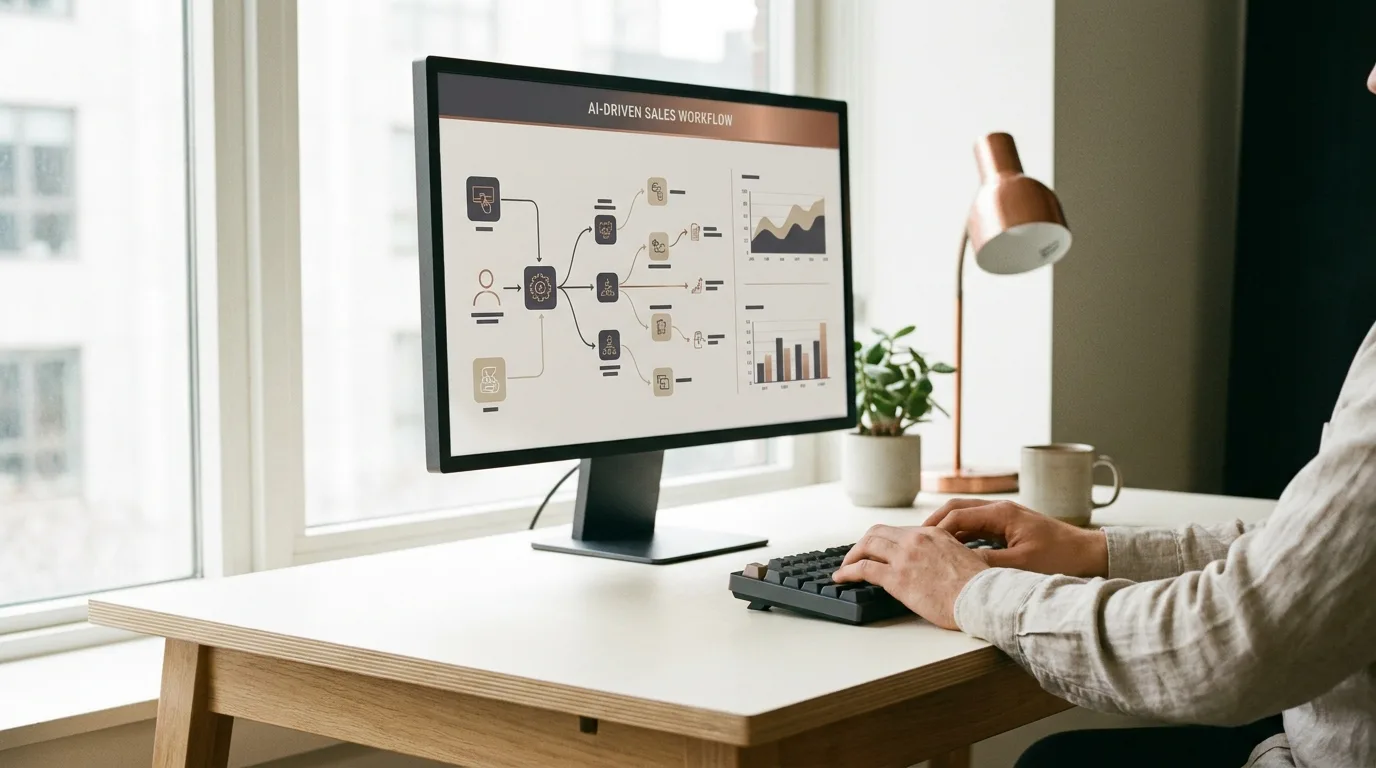
Sales professionals often assume more data leads to better results. In reality, many teams struggle because their automated ai sales assistant workflows chase volume instead of depth. When you prioritize speed over connection, prospects feel like a number in a database. That mechanical approach destroys the trust you need to close high-value B2B deals. To succeed, you must shift your focus toward the human elements of the sales conversation.
Many business owners believe they can automate the entire relationship-building process. However, trust is not something a script alone can manufacture. A generic opener usually leads to a quick hang-up or a polite rejection. By contrast, a well-researched hook proves you understand the specific challenges your prospect faces. That level of preparation requires a shift in how you deploy these tools across your sales stack.
The High Cost of Manual Prospect Research
Manual research is the biggest time-sink for modern sales development representatives. According to the Salesforce State of Sales report, reps spend only a fraction of their day actually selling. Much of the rest goes into digging through LinkedIn profiles or company websites. This research is necessary, but doing it manually does not scale for growing teams. Sales leaders need a better way to gather intelligence without burning out their staff.
When a rep spends 30 minutes preparing for a 15-minute call, the math does not work. This inefficiency limits the number of conversations your team can have in a week. The mental fatigue of scrolling through endless tabs also reduces the quality of the eventual conversation. If your team is exhausted before the call starts, they cannot perform at their peak. Better automation can solve this by delivering insights directly to the rep's inbox.
Consider the impact of a missed detail during a high-stakes meeting. If you fail to mention a recent merger or a new product launch, you look disconnected. Yet searching for these details steals time you should spend on strategy. The right technology can fill the gap by surfacing human-centric hooks automatically, so every rep enters a call with the context they need to build immediate rapport.
Why Generic Openers Fail to Build B2B Rapport
Most prospects can spot a generic opener from a mile away. Phrases like I saw your post on LinkedIn have become meaningless through overexposure. Even when true, they lack the depth required to spark a real conversation. Many prospects find these low-effort attempts more annoying than no personalization at all. Your research process must go beyond surface-level data to find unique connection points.
Rapport is built on mutual understanding and shared context. A generic script tells the prospect their time is not worth your effort. Mentioning a specific quote from a recent podcast they recorded shows genuine interest. This specificity separates a top-tier salesperson from a telemarketer. Achieving it at scale takes more than basic tooling, as these AI sales assistant rapport building hacks demonstrate.
Strategic Implementation of AI Sales Intelligence Tools
Implementing new technology takes more than a software subscription. You need a clear plan for how these tools fit your existing sales process. Many companies fail because they treat AI as a replacement for human judgment. Instead, view it as an enhancement that removes the friction of data collection. Following these methods for strategic AI sales tool implementation helps your team actually adopt these systems.
The best implementations focus on the pre-meeting ritual, the moment a rep needs high-quality data most. If the information is hard to find or outdated, reps stop using the tool. That is why automated ai sales assistant workflows must prioritize reliability and speed. A briefing that arrives one minute before a call beats a 10-page report that takes an hour to read. Focus on delivering the essential hooks that drive engagement.

Data accuracy remains a major challenge for B2B intelligence platforms. If your tools rely on faulty information, they can damage your reputation. You do not want to congratulate a prospect on a promotion that happened three years ago. As Gartner's research on sales AI highlights, high-quality data is the foundation of any successful automation strategy.
Technical Comparison: Sales Enablement vs. Sales Intelligence
It helps to distinguish between sales enablement and sales intelligence. Enablement tools focus on managing content and training for your team. Intelligence tools provide the data you need to find and engage prospects. Both matter, but they play different roles in your tech stack. Understanding the difference helps you build a more cohesive stack that supports the entire buyer journey. Use the table below to compare their primary functions.
| Feature | Sales Enablement | Sales Intelligence |
|---|---|---|
| Primary Goal | Content & Training Management | Data & Insight Gathering |
| Core Use Case | Sending Case Studies | Pre-Meeting Research |
| Output Type | Playbooks and Collateral | Firmographic & Contact Data |
| Role in AI Workflows | Content Personalization | Automated Research Hooks |
| Choose tools that integrate directly into your CRM for maximum impact. |
Combine the two categories and your team becomes far stronger. The intelligence tool finds the hook, and the enablement tool supplies the content to support the conversation. Together they create a seamless transition from research to outreach. For instance, AI can flag that a prospect cares about sustainable logistics. The enablement system can then suggest a specific white paper on that exact topic.
The Missing Link: Research Hooks in Live Meetings
Most competitors in the sales automation space focus solely on cold outreach volume. They help you send 1,000 emails, then leave you stranded once a prospect books a meeting. That is a massive gap in current sales strategies. Your automation should not stop at the first response. It should support the most critical part of the cycle: the live conversation where trust is built or lost.
A live meeting is a high-pressure environment where every second counts. You cannot afford to scroll through a LinkedIn profile while the prospect is talking. This is where automated ai sales assistant workflows that deliver pre-meeting briefings truly shine. By summarizing the prospect's background, recent achievements, and likely pain points, they let you stay focused on the human connection. You can respond dynamically instead of following a rigid script.
Effective rapport building is about showing you have done the work. Even if AI helped you find the information, having it and using it wisely is what matters. It signals a professionalism many competitors lack and becomes a genuine competitive advantage. You are no longer just another salesperson; you are a consultant who understood the business landscape before opening your mouth. These artificial intelligence sales tools strategies can sharpen that edge.
Analyzing Conversion Data: Personalized vs. Generic
The numbers tell a clear story on personalization. Research from the Harvard Business Review suggests AI can significantly improve conversion rates by enabling deeper personalization at scale. McKinsey's analysis of generative AI in B2B sales points the same way. When you use human-centric hooks, your meeting-to-opportunity rate typically climbs because the prospect feels an immediate sense of relevance.
Data-driven teams monitor the performance of different openers constantly. They might find that mentioning a prospect's alma mater works in some industries, while citing a recent white paper works better in others. Without automation, tracking these variables is nearly impossible. Automation lets you test different research angles and double down on what works. This iterative process turns sales from a guessing game into a predictable science.
Advanced Prompt Engineering for Better Prospect Research
To get the best results from AI, you must learn how to communicate with it. Simple prompts produce generic answers that do not help you build trust. Professional teams rely on sophisticated prompt engineering to extract high-value insights. Tell the AI exactly what you are looking for. Instead of asking for a summary, ask for three counter-intuitive insights about the prospect's industry.
PROMPT_STRUCTURE:
- Target: [Prospect Name]
- Context: [Company Website/LinkedIn URL]
- Instruction: Identify 3 recent professional achievements and link them to our product's value proposition.
- Constraint: Do not use generic buzzwords. Focus on specific projects or quotes from public interviews.
A structured approach like the one above keeps quality consistent. If every rep writes their own prompts, results vary wildly. A centralized prompt library lets you scale the expertise of your best researchers. It standardizes the process so every briefing meets your personalization standards. It also makes onboarding new SDRs much faster and more effective.
The goal of prompt engineering is to minimize noise and maximize signal. You want to filter out the irrelevant data that clogs traditional sales reports. Tuned correctly, your tools deliver only the most impactful hooks. That precision lets a rep build rapport in under 60 seconds. They are not sifting through data; they are absorbing insights pre-filtered for relevance and emotional impact.
Calculating the ROI of Sales Enablement Automation
Calculating the return on investment is straightforward but often overlooked. Start by measuring the time your reps spend on manual research each week. If a team of ten reps each saves five hours per week, you gain 50 hours of pure selling time. At an average hourly rate, that saving alone often covers the cost of the software. The real ROI, though, comes from the larger deals and higher win rates that better rapport produces.
Beyond time savings, consider the impact on employee retention. Reps hate tedious, repetitive work like manual LinkedIn scraping. Remove that burden and you improve job satisfaction and reduce turnover. High performers want to spend their time closing deals, not acting as data-entry clerks. Investing in this kind of automation is also an investment in your culture and long-term stability. A happy, efficient team is a more profitable team.
Overcoming the Limits of Automated Research
Even the best AI has limits you must acknowledge. It can spot patterns and gather data, but it cannot replace the human intuition complex negotiations demand. Sometimes it misses a subtle cultural nuance or a recent piece of news that has not been indexed yet. That is why your process should always include a quick human review. The goal is to give the rep a massive head start, not to do 100% of the thinking.
Transparency matters too. If a prospect asks how you knew a specific detail, being honest about your research shows professionalism. Just say you spent time reviewing their recent work to make the meeting productive. Most B2B buyers appreciate the effort. Still, if your outreach feels too robotic, it can backfire. Balance the automation with your own personality to keep the connection genuine.
Finally, rapport is an ongoing process, not a one-time event. The hooks your AI provides are just the beginning of the conversation. You must listen actively and follow up with thoughtful questions that build on that initial spark. Automation provides the foundation, but your ability to adapt in real time decides the outcome. Use the technology to open the door, then use your expertise to walk through it and close the deal.
Scaling Personalization Without Increasing Headcount
One of AI's greatest benefits is scaling without linear costs. In a traditional model, doubling outreach means doubling headcount. With sophisticated automation, you can increase output while keeping your team lean. That lets you grow your pipeline aggressively without massive overhead. It also gives your current reps the tools to manage a larger volume of high-quality leads at once.
Small teams can now compete with enterprise giants by using intelligence tools well. The barrier to entry for deep prospect research has all but disappeared. If you deliver a personalized experience to every prospect, your size matters far less. Being smaller often lets you move faster and adopt new tools more quickly than a rigid corporation. That agility is your greatest asset in a competitive B2B market.
The Future of AI Sales Assistants and CRM Integration
The next frontier is the seamless integration of research into the CRM. Instead of switching apps, reps will see human-centric hooks directly on the lead record. That reduces cognitive load and keeps the focus on the customer. Advanced tools will soon suggest the best time to call based on a prospect's online activity. This predictive intelligence will redefine what it means to be a high-performing salesperson.
We are moving from static databases toward dynamic intelligence ecosystems. These systems update in real time as prospects change jobs or companies publish new earnings. For sales leaders, the CRM becomes an active asset rather than a dusty archive. To prepare, start building the foundation for this kind of automation today. Teams that wait will find themselves at a severe disadvantage as the industry moves forward.
Trust is the currency of B2B sales, and AI is the engine that helps you earn it. By removing the drudgery of manual research, you free your team to do what they do best: build relationships. When you implement automated ai sales assistant workflows that prioritize human connection, you create a sustainable path to growth. Stop focusing on the volume of your emails and start focusing on the quality of your conversations. That is how you win in the age of AI.
The most effective sales tools are not the ones that replace the salesperson, but the ones that make them more human in the moments that matter most.
Building trust takes a commitment to excellence at every stage of the sales cycle. From the first touchpoint to the final signature, every interaction must feel personal and relevant. Smart automation makes that possible at a scale that was once unimaginable. By using technology to find the right hooks, your team always leads with value. This is not just about efficiency; it is about building a brand prospects genuinely want to work with.
In conclusion, the shift toward automation is inevitable, but how you implement it is not. You can become a volume-driven spammer or a research-backed consultant. Choosing the latter takes a thoughtful approach to automated ai sales assistant workflows that puts the human at the center. Use the insights your AI gathers to spark real, meaningful conversations. When you treat every prospect like an individual, the results follow naturally in your bottom line.
Action Steps for Implementing AI Workflows
- Audit Your Research Process — Track how much time your reps currently spend on manual LinkedIn and web research each week.
- Identify High-Value Hooks — Determine which types of personal details (awards, quotes, shared history) most effectively build rapport in your industry.
- Select an Intelligence Tool — Choose a platform that delivers pre-meeting briefings directly to your team without requiring manual searching.
- Standardize Prompting — Create a shared library of prompt templates to ensure consistent quality across all automated research outputs.
- Measure and Iterate — Compare meeting-to-close rates for calls using personalized hooks versus those using generic scripts.
Frequently Asked Questions
Can AI really replace manual LinkedIn research?
AI can automate up to 90% of the research process by scraping public data and summarizing it. However, a quick human review is still recommended to ensure the context is perfect for the specific conversation.
How does AI research automation save time?
It eliminates the need for reps to switch between multiple tabs and manually search for details. By delivering a pre-meeting briefing in under a minute, it lets reps focus entirely on strategy.
Will using AI hooks make my outreach feel robotic?
Only if you copy and paste the AI output exactly. The best approach is to use the AI-generated hooks as starting points for a genuine, human conversation.
What is the best way to integrate these workflows into a CRM?
Most modern tools offer native integrations or APIs that push research data directly into lead or contact records in Salesforce, HubSpot, or Pipedrive.